Showing posts with label Coronavirus. Show all posts

Tuesday, March 24, 2020

Bon Jovi 2020-03-24 USA Today Network (app), How Bon Jovi became the rock 'n' roll epicenter in the battle against the coronavirus

https://eu.app.com/story/entertainment/music/2020/03/24/how-bon-jovi-became-rock-n-roll-epicenter-battle-against-coronavirus/2901403001/

How Bon Jovi became the rock 'n' roll epicenter in the battle against the coronavirus


Calling Tommy and Gina.

When a group of Chicagoans wanted to unify the city with a city-wide sing-along from their window as a way of showing solidarity while Illinois is in a “stay at home” order due to the coronavirus outbreak, Bon Jovi's “Livin’ on a Prayer” was the song they chose.

“The song has this ability to make people come together,” said Jenni Spinner, an organizer of the sing-along.

Dozens of videos of the sing-along were posted. Chicago became intimately familiar with the story of Tommy and Gina, a hardscrabble couple with little but a prayer to hold them forth.

In the hours before the sing-along, two related events happened. Bon Jovi frontman Jon Bon Jovi expressed support for the sing-along and Bon Jovi keyboardist David Bryan revealed that he had tested positive for the coronavirus, COVID-19.

Bon Jovi has become the rock 'n' roll epicenter of the coronavirus outbreak. No band has stirred more empathy, articulated the feelings of uncertainty, and comforted fans with reassurance than the Jersey rockers in the first weeks of the outbreak.

Coronavirus NJ: 3 more Monmouth testing sites open

More: David Bryan, Bon Jovi keyboardist and Broadway composer, tests positive for coronavirus

More: Jon Bon Jovi is writing a song about the coronavirus outbreak and he'd like your help

“These are trying times we're going through, uncharted territory, the great unknown,” said Jon Bon Jovi on a Sunday, March 22, social media posting. “But one thing is for sure, we're going to make it through.”

Bon Jovi is the right band for the moment, fans say.

“It’s because they've always been there,” said fan Lori Franchini O'Leary, 47, of East Brunswick. “They never left no matter what year it is. They’ve always had some type of a song, some type of an album or tour for a connection with the fans. They never really left.”

The first member of the band to be affected by the outbreak was Bryan, who had his new musical, “Diana,” postponed March 12 on Broadway, as were all Broadway shows.

Then, Jon Bon Jovi and sons Jesse Bongiovi and Jake Bongiovi were shown group dancing to Doja Cat's “Say So” on the banks of the Navesink River at his home in Middletown in a March 14 video called “Quarantine Choreography” posted to the Hampton Water TikTok account and shared on a Hampton Water Instagram story.

Hampton Water is the name of the rosé sold by Jon Bon Jovi, Jesse Bongiovi and French winemaker Gérard Bertrand. The video was a fun diversion, but it certainly didn't convey the gravity of what was to come.

“I was watching that, and I was, 'What did I just watch?' " said Franchini O'Leary.

The next post, on Thursday, March 19, had a very different tone. A picture of Jon Bon Jovi, in short sleeves, washing dishes at the Soul Kitchen community restaurant in Red Bank, which he founded with his wife Dorothea Bongiovi. The Soul Kitchen restaurant is now closed due to the coronavirus outbreak, but takeout is still available for those who need it.

“If you can't do what you do ... do what you can,” commented Bon Jovi on the post.

The picture went viral.

“I thought it was very humbling,” Franchini O'Leary said. “He doesn’t just say it, he’s really actually doing it. He's totally in the present all the time. He doesn’t have people or a crew, he’s actually involved.”
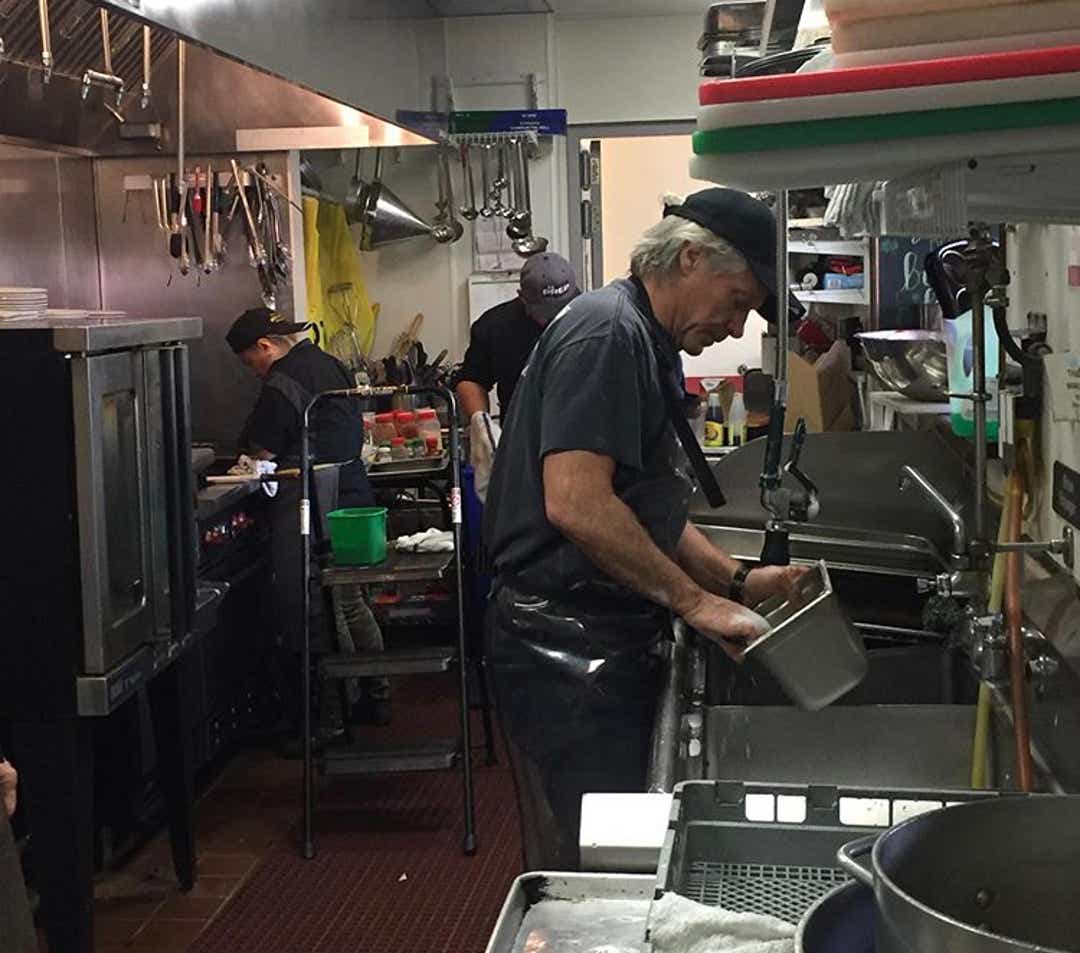
Jon Bon Jovi washing dishes at the Soul Kitchen in Red Bank on March 18, 2020.
Jon Bon Jovi/Instagram
 

The rocker has built a long resume of philanthropic and political endeavors. He served on President Obama's White House Council for Community Solutions and worked with Gov. Chris Christie on superstorm Sandy relief for Jersey, including his hometown of Sayreville. His JBJ Soul Foundation teamed with Help USA to build 51 units of affordable housing in Newark in 2008. Fifteen of the units were dedicated solely for HIV/AIDS patients.

He and Dorothea Bongiovi recently opened a Soul Kitchen on the campus of Rutgers-Newark University. It's the third Soul Kitchen location, in addition to Red Bank and Toms River. Diners pay what they can.

“Jon has been very active as a philanthropist for many, many years, and I think people know that and certainly his fans know it,” said Tony Pallagrosi, a former member of the Asbury Jukes and a Jersey Shore-based music promoter. “I think it’s a natural for him to be out in front in a situation like this. It doesn‘t surprise me.”

The appeal of Bon Jovi in this moment is partly due to the fact that Jon Bon Jovi has been a good citizen, Spinner said.

“In the Me Too era, every other day we’re finding out about somebody we’ve looked up to forever who ends up being a racist, or a Trump supporter, or a rapist or there's something about him that turns you off,” Spinner said.

“Jon Bon Jovi’s been married forever. He’s putting his money where other people's mouths are and he’s been doing good stuff and he’s been doing it for while. Not only is he not a Me Too disappointment, he’s actually doing really good stuff.”

Jon Bon Jovi and Bryan, who's also a Tony Award-winning Broadway composer, are imparting positive messages during the outbreak.

“I’ve been sick for a week and feeling better each day,” Bryan said on Saturday, March 21. His wife, Lexi Quaas, also has it. “Please don’t be afraid!!! It’s the flu not the plague. I’ve have been quarantined for a week and will for another week. And when I feel better I’ll get tested again to make sure I’m free of this nasty virus. Please help out each other. This will be over soon... with the help of every American!!”

Bon Jovi asked fans for help writing a verse of a new song, “Do What You Can,” that was partially premiered on the evening of Sunday, March 22, on Bon Jovi's social media sites. Fans were asked to video themselves singing their verse, then post it to the Bon Jovi social media sites with the #DoWhatYouCan hashtag.

“Here's my idea. We write this one together. I'm going to give you the chorus. I'm going to give you the first verse. I'm going to play the second verse, but you tell me your story,” Bon Jovi said. “Tell me what you're going through. Tell me how you're feeling. Tell me if you're hurting. Talk about that high school graduation that's going to be canceled, talk about that prom you just might not have, talk about that baby coming there's nothing you can do about that. Talk about the paycheck that you're losing. Talk about being afraid, looking out your window and wondering what to make about all of this.

“Just remember, we're going to get through it.”

Jon Bon Jovi also appears in a video for First Lady Tammy Murphy's New Jersey Pandemic Relief Fund that will assist state organizations in getting resources to vulnerable communities across the state. Bruce Springsteen, Jon Stewart, Danny DeVito, Whoopi Goldberg and Charlie Puth are also in the video, which was released on the morning on Tuesday, March 24.

“I think it's wonderful that Johnny is reaching out to lift people,” said Peter Mantas, who grew up with Jon Bon Jovi in Sayreville and spent many years working with the band. “We got each other, and that's a lot!”

Bon Jovi is scheduled to release the new album, “2020,” on May 15. The band has announced that a U.S. “Bon Jovi 2020 Tour” is scheduled to play the Prudential Center in Newark on July 14. The tour, which begins June 10 in Tacoma, Washington, also includes two shows, July 27 and 28, at Madison Square Garden, which will close the 18-date trip.

The new album promises to be more about topical subjects, the band has said.

“They have families, kids who are in their 20s, and they’re looking at what’s around them,” Franchini O'Leary said. “They're writing about what's currently around them, and it’s soldiers, it’s homelessness, it’s building homes. It's people who are less fortunate and they writing about in their songs.”

Jon Bon Jovi has his guitar at the ready.

“I'm just warming up getting ready to sing along with you. In these trying times, I am with you with all of my heart and my soul,” said Bon Jovi on Instagram prior to the Chicago sing-along. “Sing it out, baby. We're all going to come through this together.”

Chris Jordan, a Jersey Shore native, covers entertainment and features for the USA Today Network New Jersey. Contact him at @chrisfhjordan; cjordan@app.com.

Published 4:50 PM EDT Mar 24, 2020

Sunday, February 23, 2020

Covid-19 2020-02-20 The New York Times, Why Did the Coronavirus Outbreak Start in China?

I found this article very interesting about the "CoronaVirus - Covid-19" and China and its customs. I hope it will be useful to you.

https://www.nytimes.com/2020/02/20/opinion/sunday/coronavirus-china-cause.html

Opinion

Why Did the Coronavirus Outbreak Start in China?

Let’s talk about the cultural causes of this epidemic.
Mr. Lian is a former chief editor of the Hong Kong Economic Journal and a contributing Opinion writer.

Credit...Agence France-Presse — Getty Images


The new coronavirus disease has a name now: COVID-19. That took a while. The virus’s genome was sequenced within two weeks or so of its appearance, but for many weeks more, we didn’t know what to call it or the disease it causes.

For a time, in some quarters, the disease went by “Wuhan pneumonia,” after the city in central China where the first human infections were detected. But guidelines from the World Health Organization, which christened COVID-19 recently, discourage naming diseases after locations or people, among other things, to avoid “unintended negative impacts by stigmatizing certain communities.”

Indeed. On Jan. 29, an Australian tabloid owned by Rupert Murdoch featured on its front page a red face mask stamped with “Chinese Virus Pandamonium”: The emphasis on “panda” was the paper’s doing, so the misspelling it highlighted presumably was deliberate, too. A Chinese student in Melbourne protested in an op-ed in another paper, “This virus is not ‘Chinese.’”

Of course, the virus isn’t Chinese, even if its origin eventually is traced back to a cave in China; nor is the disease that it causes.

Epidemics, on the other hand, are often societal or political — much like famines are usually man-made, even though droughts occur naturally.

As far as the current outbreak goes, two cultural factors help explain how the natural occurrence of a single virus infecting a single mammal could have cascaded into a global health crisis. And now for the controversial aspect of this argument: Both of those factors are quintessentially, though not uniquely, Chinese.

The first is China’s long, long history of punishing the messenger.

A doctor who had flagged on social media the risk of a possible viral outbreak was among several people summoned by the police in Wuhan in early January and warned not to spread rumors. He died recently after being infected with COVID-19.

Similarly, the epidemic of SARS — which is caused by another coronavirus — that broke out in southern China in late 2002 was covered up by local authorities for more than a month, and the surgeon who first sounded the alarm was held in military detention for 45 days.

In 2008, a scandal erupted over tainted baby formula, after major Chinese producers were found to have added melamine to milk powder. (Six infants died; 54,000 had to be hospitalized). Four years later the whistle-blower credited with first exposing the problem was stabbed to death under mysterious circumstances.

These are recent examples, but that doesn’t mean they should be pinned solely on the Chinese Communist Party: The practice of punishing whoever brings embarrassing truths has been the order of the day since at least the time of Confucius, in the sixth century B.C.

The sage took a page from an even more ancient tract, “The Classic of Poetry” (also known as “The Book of Songs”), a collection of songs and poems dating to the 10th century B.C. or before, and adopted a rule from it: “To Manifest the Way, First Keep Your Body Safe.” (明哲保身) That may sound innocuous enough, until you consider the fate of one of Confucius’s beloved students, Zi Lu (子路), also known as Zhong You (仲由), after he ran afoul of the precept: For trying to rebuke a usurper in a power struggle between feudal lords, he was killed and his body was minced. (It is said that Confucius never ate ground meat again.)

In the third century, the maxim took on some literary flair and a cynical didactic twist in an essay on fate by the philosopher Li Kang (李康): “The tree that grows taller than the forest will be truncated by gales” (木秀于林,風必催之). This, in turn, eventually gave rise to the more familiar modern adage, “The shot hits the bird that pokes its head out” (槍打出頭鳥).

Admittedly, China’s rulers occasionally solicit honest views from their subjects — but only of a certain kind or usually for a limited time. Mao Zedong, in his “Hundred Flowers” or “Big Voices, Big Gripes” (大鳴大放) campaign of late 1956 and early 1957, called for the facts and critical opinions to be freely proffered. A few months later came the Anti-Rightist Movement (反右運動) — during which hundreds of thousands of educated people who had spoken out were sent to jail, forced into exile or subjected to years of mistreatment, their careers and families destroyed.

Punishing people who speak the truth has been a standard practice of China’s ruling elite for more than two millenniums and is an established means of coercing stability. It is not an invention of modern China under the Communists — although the party, true to form, has perfected the practice. And now, muzzling the messenger has helped spread the deadly COVID-19, which has infected some 75,000 people.

A second cultural factor behind the epidemic are traditional Chinese beliefs about the powers of certain foods, which have encouraged some hazardous habits. There is, in particular, the aspect of Chinese eating culture known as “jinbu,” (進補) meaning, roughly, to fill the void. Some of its practices are folklorish or esoteric, but even among Chinese people who don’t follow them, the concept is pervasive.

It is better to cure a disease with food than medicine, so starts the holistic theory. Illnesses result when the body is depleted of blood and energy — though not the kind of blood and energy studied in biology and physics, but a mystic version.

Credit...Anti-Poaching Special Squad, via Associated Press


For men, it is most important to fill the energy void, which is related to virility and sexual prowess; for women, the stress is on replacing blood, which improves beauty and fertility. Rare plants and animals from the wild are thought to bring the best replenishment, especially when eaten fresh or raw. Winter is said to be the season when the body needs more “jinbu” foods. (Could that help explain why both SARS and the current epidemic broke out during that time of year?)

Hard-core believers in “jinbu” seem to buy into this notion, too: “Like-shapes eaten strengthen like-shapes” (以形補形), with the word “shapes” sometimes referring to human organs and their functions. Adherents count as favorites a long list of exotic foods — whose methods of procurement or preparation can be outright cruel, with some simply too revolting to describe here.

I’ve seen snakes and the penises of bulls or horses — great for men, the theory goes — on offer at restaurants in many cities in southern China. Bats, which are thought to be the original source of both the current coronavirus and the SARS virus, are said to be good for restoring eyesight — especially the animals’ granular feces, called “sands of nocturnal shine” (夜明砂). Gallbladders and bile harvested from live bears are good for treating jaundice; tiger bone is for erections.

More mundane yet no less popular is the palm civet (果子狸), a small, wild quadruped suspected of having passed on the SARS virus to humans. When stewed with snake meat, it is said to cure insomnia.

Less wealthy people might turn to dog meat — preferably a dog that has been chased around before being slaughtered, because some people believe that more “jinbu” benefits are reaped from eating an animal whose blood and energy ran high. Similarly, it is thought that animals killed just before serving are more “jinbu” potent, which is one reason the more exotic offerings in wet markets tend to be sold alive — also making them more potent vectors for any virus they might carry.

Eating exotic wildlife has long been endorsed by scholars and elevated to mystical heights, including in the medical treatise “The Inner Bible of the Yellow Emperor” (黃帝内經), written some 2,000 years ago and still revered by many health-conscious Chinese today. Beliefs surrounding the health benefits of certain wildlife foods — which are discussed in newspaper columns and on numerous dedicated internet sites, as well as taught in China’s medical schools — permeate the culture.

True, these practices are not legion across China. Nor are they uniquely Chinese: Many peoples in many other countries eat exotic foods, too. But what is notable about China is that these beliefs about the special powers of some foods have been accepted, are now a given, even among people who do not put them into practice. They have become firmly embedded in the Chinese collective consciousness.

And so there are strong reasons to say that the current outbreak of COVID-19 has been aided by two fundamentally Chinese cultural practices. This may be discomfiting to hear; the notion might even strike some people as offensive. But it is necessary to investigate all the causes behind this deadly epidemic, whatever their nature — because if we don’t, we will only be inviting the next one.

Yi-Zheng Lian, a commentator on Hong Kong and Asian affairs, is a professor of economics at Yamanashi Gakuin University in Japan and a contributing Opinion writer.

The Times is committed to publishing a diversity of letters to the editor. We’d like to hear what you think about this or any of our articles. Here are some tips. And here’s our email: letters@nytimes.com.

Follow The New York Times Opinion section on Facebook, Twitter (@NYTopinion) and Instagram.

A version of this article appears in print on Feb. 23, 2020, Section SR, Page 2 of the New York edition with the headline: The Coronavirus and ‘Jinbu’ Foods. Order Reprints | Today’s Paper | Subscribe